How to Read a Balance Sheet
Most small business owners have a Balance Sheet sitting in their accounting software that they’ve never actually opened.
That’s not laziness. The Profit and Loss statement answers the question you ask every day — did I make money this month? The Balance Sheet answers a quieter one, and it doesn’t feel urgent until the day it suddenly does: what is this business actually worth right now, and how much of it do you really own?
It’s not a difficult report once you know what you’re looking at. Here’s the whole thing, properly explained.
What a Balance Sheet Actually Is
A Balance Sheet is a snapshot of your business on one specific day. Not a month, not a year — one date. It has three parts, and they always balance against each other.
Assets — everything the business owns or is owed. Cash in the bank, unpaid invoices customers still owe you, equipment, inventory, a deposit sitting with a landlord.
Liabilities — everything the business owes to someone else. A loan, unpaid supplier bills, tax you’ve collected but haven’t paid yet, a credit card balance.
Equity — what’s left once you subtract what you owe from what you own. This is the actual value of the business: the part that belongs to you.
Those three add up to one equation that never breaks:
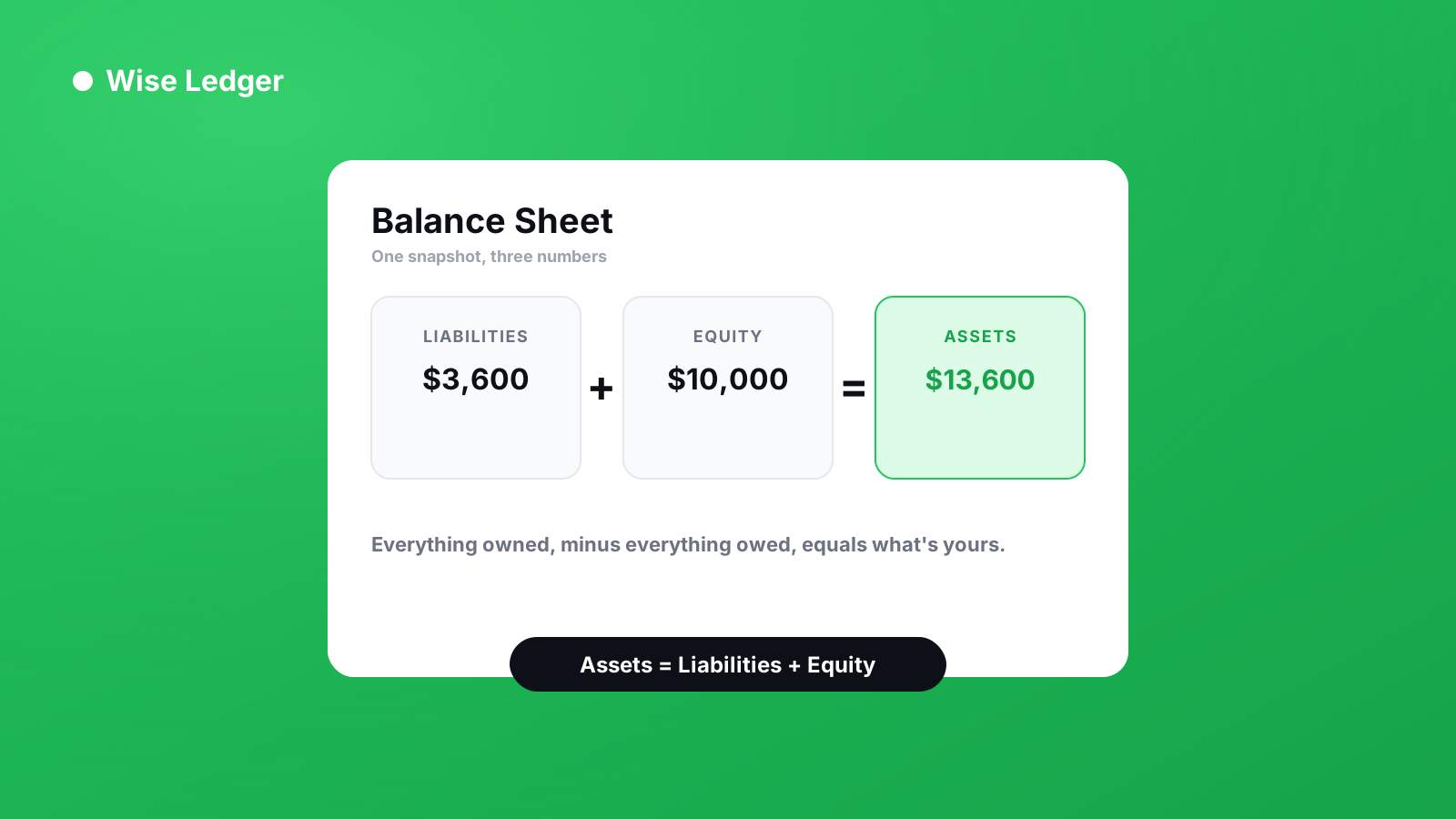
Assets = Liabilities + Equity
If it doesn’t balance, something’s been recorded wrong somewhere. That’s the whole point of the name. Every asset in the business was paid for one of two ways — money you borrowed, or money you put in and kept — and the equation is just that fact, stated as arithmetic.
How to Actually Read One
Numbers make this concrete faster than definitions do. Here’s a simple Balance Sheet for a one-person consulting business, as of 30 June.
| Assets | |
| Cash in the bank | $8,400 |
| Unpaid client invoices | $3,200 |
| Laptop and equipment | $2,000 |
| Total assets | $13,600 |
| Liabilities | |
| Business credit card | $1,100 |
| Tax set aside, not yet paid | $2,500 |
| Total liabilities | $3,600 |
| Equity | $10,000 |
Read it in this order.
Total assets is $13,600 — everything the business currently owns or is owed, added up. Total liabilities is $3,600, everything it owes someone else. Equity is what’s left: $13,600 minus $3,600 is $10,000. That’s the actual worth of the business today. Not what it made this month. What it’s worth if every debt got settled right now.
Two things worth noticing in that example. The unpaid client invoices count as an asset even though the cash hasn’t arrived yet, because it’s money owed to the business — it belongs on the Assets side, not on the P&L as income until it lands. And “tax set aside, not yet paid” is a liability, not an expense. It’s money the business is holding but doesn’t actually own, because it’s earmarked to leave.
That’s the skill, really. Not memorising terms. Just sorting each number into the right one of three buckets, then trusting the equation to check your work.
Why Most Small Business Owners Never Look at Theirs
Ask a business owner how last month went and they’ll usually answer from the P&L: revenue, expenses, profit. Ask what the business is actually worth and most people go quiet. Not because they don’t care, but because nobody ever pointed them at the report that answers it.
A few reasons the Balance Sheet gets skipped.
The P&L answers the question people actually ask themselves. “Did I make money this month?” comes up constantly. “What is my business worth today?” comes up rarely — until a loan application or a buyer asks it directly, and then it’s the only number that matters.
It looks like an accounting document, not a business one. Assets, liabilities, equity: the vocabulary alone is enough to make people assume it’s for the accountant, not for them. It isn’t. It’s the difference between someone else translating your business for you and reading it yourself.
A small business doesn’t feel like it has a “balance sheet situation.” It can feel like a report built for a company with more moving parts — more inventory, bigger loans, outside shareholders to answer to. But even a business with nothing but a laptop and a bank account has assets, liabilities, and equity. They’re just smaller and fewer.
None of that makes the report less useful. It just means most people go years without checking whether the thing they built is actually worth what they assume it is.
Where Wise Ledger Fits
Wise Ledger generates a Balance Sheet automatically from the income and expenses you’re already recording. There’s no separate setup and no journal entries to learn. Every invoice, payment, and expense you log updates it in real time, so the three totals are current, not something you assemble once a year for an accountant.
Balance Sheet is a Pro feature — the free plan covers Profit & Loss, and upgrading unlocks Balance Sheet, Cash Flow, and tax estimates alongside it. It won’t do anything an accountant’s version doesn’t: the arithmetic is the arithmetic. What it does is put the report in front of you without asking you to learn double-entry bookkeeping first.
Frequently asked questions
How often should I look at my Balance Sheet? Once a month is enough for most small businesses, ideally alongside your Profit and Loss. It won’t move dramatically week to week, but checking monthly catches problems — like liabilities creeping up faster than assets — while they’re still small.
What does a “healthy” balance sheet look like for a small business? There’s no single number, but the general signal is assets comfortably ahead of liabilities, with equity growing over time rather than shrinking. A business with more debt than it owns, or equity that’s falling quarter over quarter, is worth investigating before it becomes urgent.
Why doesn’t my Balance Sheet match my bank balance? Because assets include things beyond cash — unpaid invoices, equipment, inventory — and your bank balance is just one line on it. If you want cash specifically, that’s what the bank balance and Cash Flow statement show. The Balance Sheet is the wider picture of everything owned and owed.
Do I need a Balance Sheet if I’m a sole trader with no employees? Yes, though it’ll be simpler than a larger company’s. Even one person with a laptop and a bank account has assets, liabilities, and equity. It matters most the moment you apply for a loan, bring on an investor, or just want an honest answer to what this is actually worth.
A Balance Sheet isn’t a harder report than the one you already check every month. It just answers a different question. Once you know the three buckets and trust the equation, reading one takes less time than reading your P&L. The only real step is opening it.
See what you've really made — and what you're still owed.